

Work made in Germany
How employers create good jobs
The bureaucratic burden on German businesses has risen significantly over the past three years businesses urgently need relief
Over the past three years, businesses have had to hire an additional 325,000 workers to cope with the increased bureaucracy. Bureaucracy increases costs and reduces productivity_as shown by a recent survey by the IAB Forum (Diegmann & Kubis, 2025). Businesses urgently need relief. Reducing bureaucracy strengthens our competitiveness!
“Made in Germany” stands for more than just sophisticated technology—it stands for a work culture that sets the standard. Great work is created where corporate responsibility meets crea-tive vision.
In German companies, work is not merely organized—it is actively and proactively shaped. Al-ways with an eye on the challenges and opportunities of our time: from digitalization and artifi-cial intelligence to demographic change and securing skilled workers, all the way to mental health and the desire for a better work-life balance.
Whether a large corporation or a family business—everywhere, employers demonstrate how good work is achieved: with fair pay, social security, safe working conditions, as well as flexibility and targeted training opportunities. This is also reflected in the numbers: job satisfaction has remained consistently high for years.
“Work made in Germany” is thus a true seal of quality—for quality, participation, and sustainability. Because companies are already thinking about tomor-row’s work today. And good work creates a future: for employees, for businesses, and for our country.








A quick chat
Steffen Kampeter
BDA-CEO
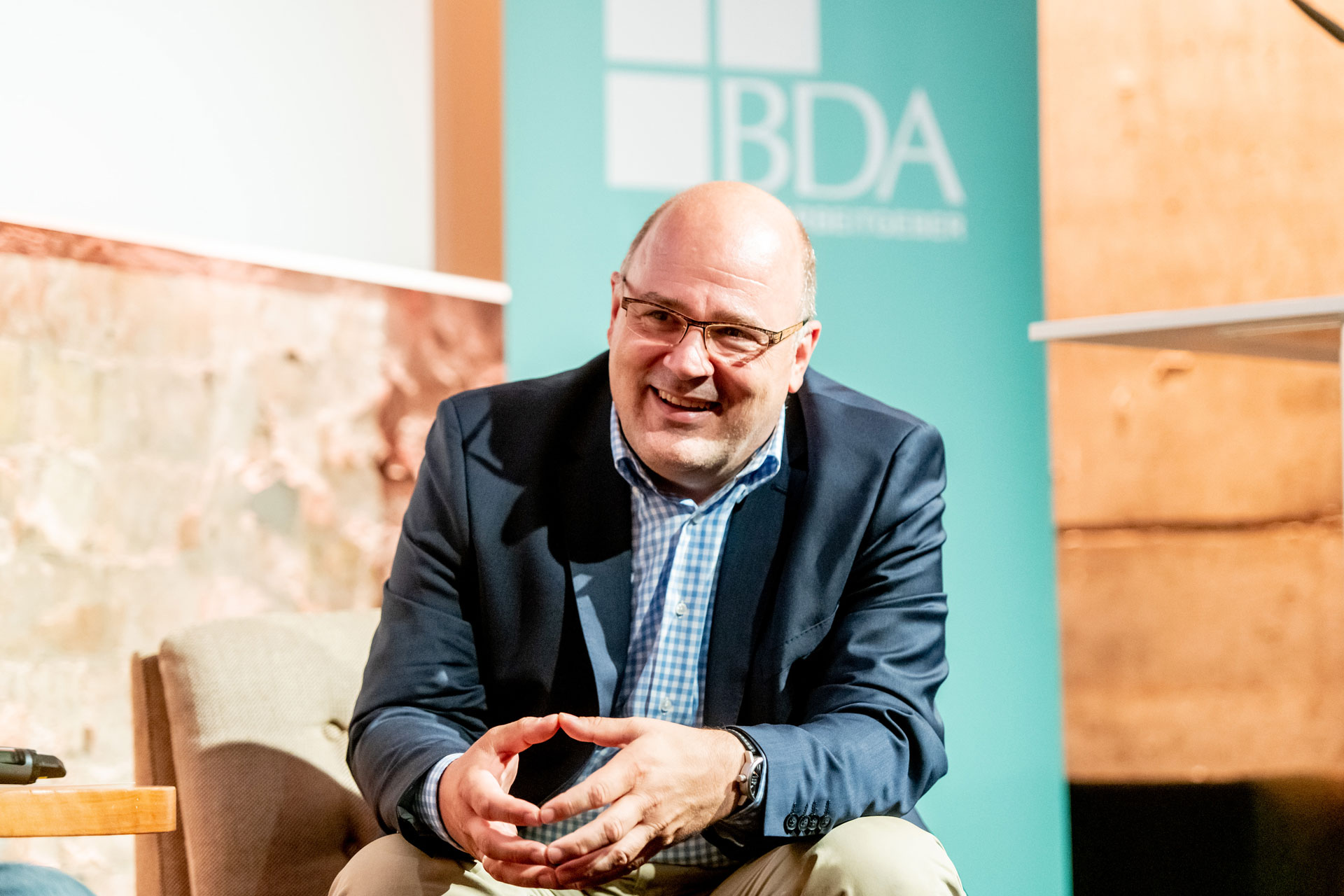
“Good work in Germany is not a given. ‘Made in Germany’ stands for a work culture that com-bines quality, responsibility, and participation. Our social market economy works—because companies shape the workplace every day and align entrepreneurial dynamism with the needs of their employees. The high level of employee satisfaction shows that this approach is working. To ensure that ‘Work made in Germany’ continues to stand for quality, participation, and innova-tive strength in the future, more than just corporate commitment is needed. It requires the polit-ical will to create framework conditions that enable good work—especially now, when economic uncertainties, technological upheavals, and the shortage of skilled workers demand new solu-tions. Anyone who wants work in Germany to remain a seal of quality must be willing to actively shape it.”
Steffen Kampeter
BDA-CEO
In short:
What sets “Work Made in Germany” apart
1
HIGH JOB SATISFACTION
Job satisfaction and motivation levels have remained consistently high among 90% em-ployees since the 1990s. The turnover rate is lower than it was before the pandemic.
2
GOOD WORKINGCONDITIONS
Working conditions are good: since 2018, resources in the workplace have continued to increase. Work provides stability, social inclusion, and a sense of purpose, making it an important protective factor against mental illness.
3
LOTS OF EXTRAS
Employers contribute a significant portion—34%—to their employees’ social security cov-erage, including benefits for old age, unemployment, illness, accidents, and long-term care. In addition, they provide numerous voluntary benefits
4
WORK PLUS HEALTH
Health promotion and occupational safety are proving successful: an increasing number of companies are implementing systematic risk assessments—including 85% of small busi-nesses. The number of workplace accidents is at an all-time low. Nearly 80% of employees feel they receive good to very good support in occupational safety. The number of early retirements due to health reasons has also fallen by about 44% since 1995.
5
MORE FLEXIBILITY
Flexibility is a must-have for both companies and employees. When used effectively, it gives both sides a greater leeway to meet the demands of the global market and their personal lives.
6
DIVERSITY AS A DRIVING FORCE
Despite the slowdown in the German labor market, many companies are facing a shortage of workers and skilled personnel. The economy relies on the skills, knowledge, and crea-tivity of every individual, regardless of perceived differences such as background, gender, or religion. Companies are fostering and harnessing diverse talents.
7
FUTURE WORK
Digitalization and AI are already helping to improve working conditions: they make work more flexible, and new technologies promote workplace safety and inclusion, thereby helping as many people as possible to continue working until they reach the statutory re-tirement age and beyond.
8
COMMITMENT TO CONTINUING EDUCATION
Companies are the largest providers of continuing education in Germany. 93% of all com-panies are involved in continuing education and invest approximately 46.4 billion euros annually.
How Employers Create Good Jobs
Creating Good Work
A good job is important.
It should not only be a source of income, but also provide a sense of purpose, bring joy, and be challenging — yet neither too demanding nor too easy. Good working conditions ensure that employees remain healthy and motivated. This is essential for attracting new talent and retain-ing current employees. A strong workforce keeps companies competitive, innovative, and high-performing.
Good benefits,
pay, and perks
Employees in Germany enjoy a high level of social security,
not only in the event of illness or unemployment, but also in times of crisis. In their working lives, they can take advantage of many voluntary supplementary benefits offered by their em-ployers.
The interplay
between health and work
Work not only provides a livelihood; it also gives meaning to life,
brings satisfaction and fosters social recognition (Knieps & Pfaff, 2020; WHO, 2024). According to a study by the Robert Koch Institute, mental well-being is highest among those in full-time em-ployment, followed by people in part-time or marginal employment, homemakers and unem-ployed people (Thielen & Kroll, 2013).
What's the deal
with work and mental health, anyway?
Mental health is a key foundation for motivation, productivity and quality of life.
Employers are committed to ensuring that employees can work in good health – both physically and mentally. After all, good work means more than just job security: it also creates stability, social integration and a sense of purpose. At the same time, companies face the challenge of ensuring their working conditions remain safe and healthy, even in the face of changing de-mands such as digitalisation and skills shortages. Furthermore, many employers voluntarily en-gage in workplace health promotion.
New Time, New Place: EN
Flexibility in the Workplace
Flexibility is a must-have; not only for many employees, but above all for companies.
For them, flexibility does not only mean adapting to fluctuating orders, customer demands, and the company’s situation. Above all, flexibility also provides the opportunity to respond to un-foreseen situations, such as machine stoppages, supply shortages, or the sudden absence of em-ployees. Geographical flexibility can—where possible—offer the chance to attract skilled work-ers who, for example, could not be on-site full-time due to family circumstances. Through com-pany-provided flexibility options—in coordination with their employer—employees can shape their own working day and career path more individually. In many cases, a win-win.
Digitalization and AI:
a wealth of opportunities for Employees and Businesses
Digitalization—particularly the use of artificial intelligence (AI) — is fundamentally transforming the world of work.
It offers companies and employees enormous potential: for greater efficiency, better working conditions, new forms of collaboration, and increased competitiveness. At the same time, it opens new avenues for inclusion, upskilling, and meaningful work.
Companies draw on
diverse labour and skills potential
Despite the cooling of the German labour market, many companies continue to face shortages of labour and skilled workforce.
Businesses are striving to leverage all available talent. The economy depends on the skills, knowledge and creativity of every individual, regardless of their background, gender or other diversity traits.
Education
creates career opportunities
Education pays off.
It is the foundation for long-term success and competitiveness. Employers recognise this and are fully committed to the initial and continuous training of their staff. Every year, the German economy invests around 78 billion euros in training. In doing so, it not only makes a vital contri-bution to securing a skilled workforce, but also to social prosperity.