
Education
creates career opportunities
VET: A guarantee for employment and the royal road for skilled workers
Beyond vocational education and training (VET), employers are involved in numerous and diverse initiatives and projects across the entire education chain, from early childcare to higher education. For example, on the initiative of the NORDMETALL Foundation, the MINIPHÄNOMENTA science discovery centre sparks an interest in the natural sciences among children and young people. The Foundation of German Business (sdw) promotes commitment, initiative and entrepreneurship: it offers 10 scholarship and support programmes for school pupils, apprentices, students and young professionals. And around 9,000 companies of various sizes and from a range of sectors – from international IT giants to local window manufacturers – cooperate with the Baden-Württemberg Cooperative State University (DHBW). In doing so, they provide young people with an excellent, practice-oriented education.
…aller Auszubildenden werdenvon den Unternehmenübernommen.

©AdobeStock / Robert Kneschke
VET: A guarantee for employment and the royal road for skilled workers
By providing excellent VET, companies are securing the skilled workers of tomorrow
Graduates of VET programmes are a cornerstone of our country’s efforts to secure a skilled workforce. Every year, companies in Germany train almost half a million apprentices. The current record high in the number of apprentices being offered permanent employment after graduation (2024: 79%; 2010: 61%) shows that these skilled workers are needed more urgently than ever before. Training companies are very well placed to prepare their young talent for working life in a practical and successful manner. There is a large number of companies who go above and beyond to provide excellent training. This ranges from projects to integrate refugees, through supporting stays abroad, to initiatives aimed at fostering democratic education among young people.
More and more companies are enabling their trainees to undertake learning stays abroad – thereby making VET more attractive than ever. In 2024, 45% more young people completed an international internship through Erasmus+ than in the previous year (BIBB, 2025). This shows that employers recognise the value of international experience and are investing specifically in the future of their skilled workers.
Master craftsmen and academics on an equal footing
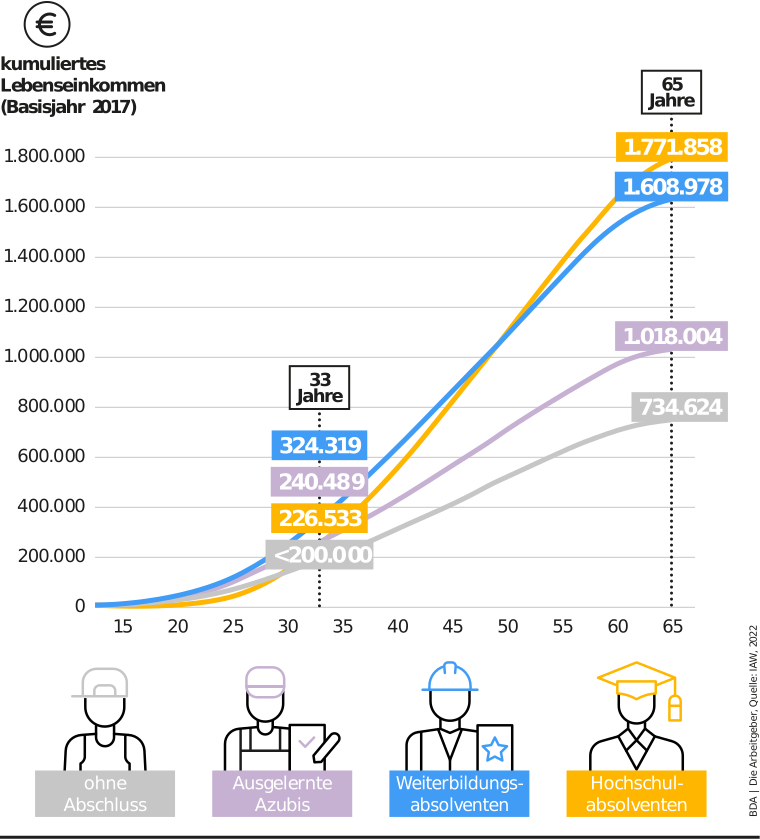
For high-achievers with a dual vocational qualification or an academic degree, advanced training leading to the role of master craftsman, technician, specialist or business administrator is an attractive option alongside in-company further training: For instance, master craftsmen and technicians have a similar average lifetime income (€1.6 million gross) to academics (€1.7 million, IAW, 2022).
Lebenseinkommen von Hoch- und Weiterbildungsabsolventen
Weiterbildung zahlt sich aus
Bis zu einem Alter von 33 Jahren habenausgelernte Azubis (240.489,00 €)insgesamt mehr Geld verdient als Hochschulabsolventen (226.533,00 €).Wer nach der Ausbildungsprüfung eine Weiterbildung gemacht hat, landet mit 33 sogar schon bei 324.319,00 €. Am wenigsten verdienen diejenigen ohne Abschluss.
Meister oder Techniker verdienen bis zu einem Alter von 50 Jahren und damit den größten Teil ihres Berufslebens mehr als Personen mit einem Hochschulabschluss.
Über das gesamte Berufsleben hinweg erzielen Hochschul- und Weiterbildungsabsolventen im Durchschnitt ein vergleichbares Lebenseinkommen
Quelle: IAW, 2022
Employers play an active role in shaping the VET:
Together, the social partners take responsibility for ensuring that initial VET and further training programmes are tailored to the needs of industries and companies, and that their graduates are therefore highly valued in the labour market. Digital skills also play an important role in this regard. VET in Germany contributes significantly to the very low youth unemployment rate, currently standing at just 5.7% (BA, 2025). An international comparison also makes it clear: the dual training system works and facilitates entry into the labour market. In October 2025, the youth unemployment rate across the EU stood at 15.2%. Germany also performs significantly better based on EU statistics compiled using other criteria: only 6.6% of 15- to 24-year-olds are unemployed – less than half the EU average (Destatis, 2025d).
Thanks to the significant practical component of the training, young people benefit from learning directly in the workplace from experienced colleagues and ‘on the job’. Companies, in turn, benefit from their investment, as they train skilled workers who meet their needs, get to know them well during their training and can retain them. It is no coincidence that, according to the IAB, 79% of all trainees were taken on by their training company upon successful completion in 2025 (IAB, 2025). Drop-out rates are low at around 15% (BIBB, 2024). By way of comparison: around 28% of bachelor’s degree students drop out of their studies (DZHW, 2022). The strong commitment of companies in Germany to VET is also reflected in the financial figures: overall, the business sector invests around €31 billion annually, which amounts to more than €26,000 per trainee! According to the IAB Business Panel, of the companies authorised to provide training (51%), 45% provide training continuously and 37% with interruptions (IAB, 2023).
Further training: Essential for Work 4.0
Particularly in light of the digital transformation, it is becoming increasingly important for employees to enhance their skills through further training. ‘Lifelong learning’ is also in the interests of companies. Consequently, companies themselves are the largest providers of further training. Around 93% of all companies are involved in further training and invest 46.4 billion euros annually (IW, 2023). Vocational further training is a shared responsibility between employers and their employees. Today, around 90% of recorded further training hours take place during working hours. Employees also benefit directly from further training because it allows them to update their specialist knowledge, acquire new skills and secure their employability.
Digital skills – their importance for skilled workers and in VET
Percentages (rounded) of companies that consider digital skills to be (very) important for their skilled workers and teach these skills (very) intensively during training. Sorted by rank of the intensity with which digital skills are taught during training, based on the proportion of companies that teach these skills very intensively or fairly intensively.
We demand:
Higher education and VET: The economy needs both – and a combination of the two!
The German economy offers excellent opportunities for graduates of both educational pathways: VET and higher education. The dual study programme, which combines vocational training with university study, is a successful model, partly because companies are heavily involved:
- Of the 2.89 million students, over 140,000 are currently completing their first degree in one of more than 1,750 dual study programmes;
- around 53,000 companies participate in dual study programmes (BIBB, 2025).
It is an attractive, practice-oriented form of study, particularly for high-achieving young people, and the rates at which graduates are taken on by companies after graduation are high. Further expansion of this range of courses is therefore a worthwhile objective. This requires a broader range of subjects – extending beyond economics, engineering and computer science – as well as the avoidance of new regulations and bureaucratic hurdles.
Further information:
- BDA publication The Formula for the Future: STEM Education. Eight Keys to Progress, Prosperity and Security
- BDA-Publikation Education 2030 in Focus
- BDA-Position The Dual Study Programme: A Model for Success – A Guide for Businesses (joint publication by the BDA and the Stifterverband)
- Stiftung der Deutschen Wirtschaft: a non-profit educational foundation of the German business community that supports young people with scholarships and funding programmes to promote equal opportunities, strengthen personal initiative and accompany them on their educational journey – from school pupils to PhD students.
- BDA publication Democracy education throughout all levels of education
- SCHULEWIRTSCHAFT: Within the SCHULEWIRTSCHAFT network, local schools and businesses work together in partnership to pave the way for young people into the world of work
- Berufswahl-SIEGEL: Mit dem Berufswahl-SIEGEL zeichnen wir Schulen für die Umsetzung einer exzellenten Berufs- und Studienorientierung aus
- MINTvernetzt: Service and contact point for the community of STEM stakeholders in Germany