
Good benefits,
pay, and perks
German companies pay good wages
Employers in Germany pay particularly good wages and salaries. Most recently, the average gross annual income of a full-time employee was over 62,000 euros (Destatis, 2025a). The total amount of all gross wages and salaries paid in Germany in 2024 was more than 1.9 trillion euros. Taking into account the social security contributions paid by employers, total employee compensation amounted to over 2.3 trillion euros last year alone. Over the past 10 years, earnings have developed positively—despite the economic challenges caused first by the COVID-19 pandemic and then by the effects of Russia’s war of aggression against Ukraine. (Destatis, 2025a). Monthly gross and net wages and salaries per employee rose by a total of more than 34% during this period (Destatis, 2025b).
... is the average gross annual earnings of a full-time employee.
Workers in Germany enjoy a high level of social security, not only in the event of illness or unemployment, but also in times of crisis.
Employers largely finance the comprehensive social security system
We live in a welfare state that has often had to prove its worth in recent years of crisis. And despite the many crises (such as the pandemic, inflation, and wars), our welfare state offers a high level of protection and safeguards employees in almost all circumstances: For example, they receive protection in the event of (impending) job loss, illness, the need for long-term care, accidents, and old age. Together with their families, they also benefit from a wide range of family-related benefits, such as maternity pay, parental leave benefits, child benefits, and the non-contributory co-insurance of family members under statutory health insurance. In total, more than 1.3 trillion euros are spent in Germany on financing social benefits.
Employers pay a significant portion of these benefits, accounting for around 34% (BMAS, 2025). Not only do they pay social insurance contributions together with employees for pension, health, long-term care, and unemployment insurance, but they also fully cover the six-week continued pay in the event of illness, the costs of statutory accident insurance, insolvency benefits, and the subsidies for maternity benefits for 14 weeks [see Fig. 2].
Good to Know
In den letzten 10 Jahren haben sich die Verdienste – trotz der wirtschaftlichen Herausforderungen verursacht zunächst durch die Corona-Pandemie und dann durch die Auswirkungen des russischen Angriffskrieges auf die Ukraine – positiv entwickelt. (Destatis, 2025a). Die monatlichen Brutto- und Nettolöhne und -gehälter je Arbeitnehmerin und Arbeitnehmer stiegen in diesem Zeitraum insgesamt um mehr als 34 % (Destatis, 2025b).
Well-covered in case of illness
When employees fall ill, most employers not only provide three days of sick leave during which a doctor’s note is not required—but also continue to pay wages for an additional six weeks regardless of the diagnosis. In 2024, employers paid 82 million euros (including social security contributions) for this coverage of their employees, which is 10 million euros more than two years ago (IW, 2025). These costs thus exceeded all long-term care insurance expenditures, all unemployment insurance benefits, and the expenditures of every federal ministry—including the Ministry of Defense (with the exception of the Federal Ministry of Labor) (BDA, 2025). By European standards, Germany thus ranks at the top (Euronews, 2023).
Social security contributions and continued pay by employers for sickness, unemployment, long-term care insurance, pensions, and workplace accident insurance (excluding maternity leave)
(For detailed information, hover your mouse over the bars.)
2023: temporary
2024: estimated
Source: IW, 2025
Financial Security in Old Age
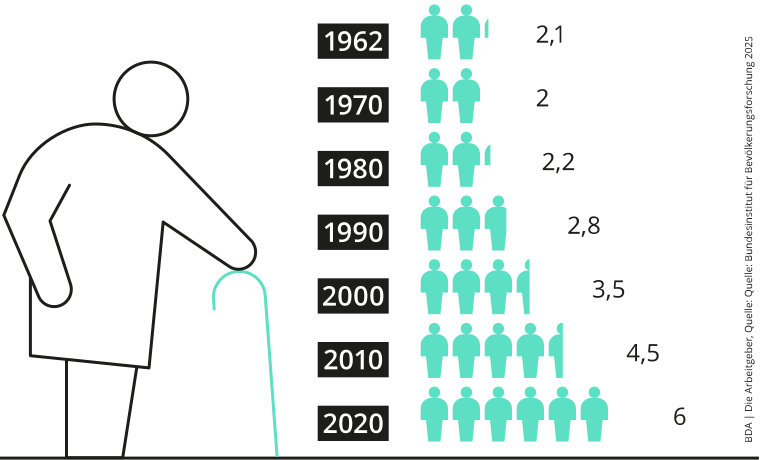
This may come as a surprise given the media debate—but it is nevertheless well supported by figures, data, and facts: workers enjoy good financial security in old age. In its latest Pension Security Report, the federal government notes that it is “largely well provided for” today’s generation of retirees. According to the report, the average monthly net income in Germany for people aged 65 and older in 2023 was 3,759 euros for married couples, 2,213 euros for single men, and 1,858 euros for single women. On average, the net household income was thus 2,769 euros and has risen by 25% since 2019 (BMAS, 2024). Nevertheless, far fewer people are financing a single pensioner’s retirement today than 60 years ago—back then, there were six contributors for every pensioner; today, there are only two [see Fig. 2].

©Pixabay: Sabine van Erp
A Secure Pension for the Future: Planning Together for Tomorrow
The statutory pension insurance system is a proven cornerstone of our retirement planning. However, demographic change confronts us with new challenges: Fewer and fewer workers are funding the pensions of more and more people [see Fig. 3], who, fortunately, are living longer and thus receiving pensions for longer. This development is a sign of social progress—but it also means that young people and families today must contribute significantly more to funding the system than previous generations. To ensure that pensions remain reliable for everyone in the future, we need smart and fair reforms now.
This includes ensuring that the burden is distributed fairly between contributors and pension recipients. The pension formula must be adjusted to reflect these changed circumstances. A moderate extension of the working life can also help stabilize the system—as can strengthening occupational and private pension plans.
Our goal must be a pension system based on solidarity and future-proofed, one that connects generations rather than playing them off against one another.
Contributors per old-age pensioner in the statutory pension insurance system
Source: Federal Institute for Population Research, 2025
Durchschnittliche Rentenbezugsdauer gesetzlich Versicherter 1960–2020
Source: Federal Institute for Population Research, 2025
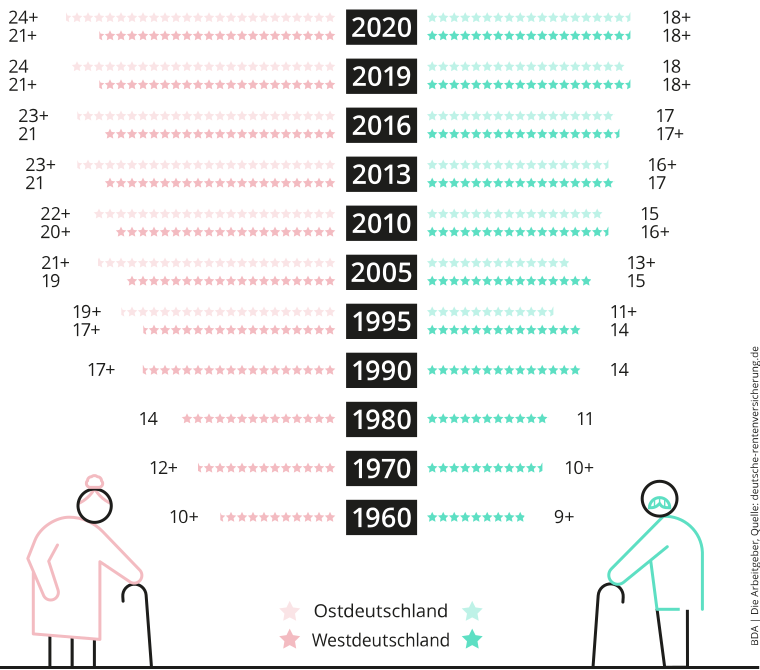
Die durchschnittlichen Rentenbezugsdauern sind für jedes Jahr als Querschnitt berechnet und durch Rechtsänderungen, Sondereffekte und durch sich im Zeitablauf ändernde Altersstrukturen beeinflusst.
Vor 1980 ohne Knappschaft, da eine Geschlechtertrennung nicht möglich ist.
Employers also provide many voluntary benefits on top of that
In addition to high wages and comprehensive social security coverage, employees in Germany can benefit from many voluntary perks that their employers provide for them. The most significant voluntary benefit offered by employers is the company pension plan. Annual expenditures on occupational pension plans total 39.5 billion euros, of which approximately 75.2% is financed by employers (BMAS, 2025). Today, there are approximately 21 million active occupational pension entitlements—that is, entitlements for which contributions were paid or additional benefits were accrued in the respective year. Approximately 18.1 million employees in the private sector and public service have at least one additional occupational pension (or a corresponding entitlement) (BMAS, 2024a). Agreements on occupational pension plans have been reached in over 400 collective bargaining agreements covering around 20 million employees. In many cases, these agreements also stipulate employer contributions. This has helped increase the prevalence of occupational pension plans even in sectors that were previously underrepresented (e.g., retail or the hotel and restaurant industry).
We demand:
Ensuring Good Wages and Strong Social Security for the Future
Germany stands for fair wages and a reliable social safety net. To ensure this remains the case in the future, we need sustainable solutions that both strengthen the economy and safeguard social security. After all, when companies remain competitive, they can create good jobs—and employees benefit from stable social benefits.
Ideas for a sustainable and equitable social policy:
- Capping Social Security Contributions: A cap of 40% ensures that non-wage labor costs remain predictable. This strengthens companies’ competitiveness and protects jobs.
- Making Pensions Fair and Sustainable: Demographic trends require balanced intergenerational financing. A longer working life and fair distribution of the burden help keep the pension system stable—for today’s and tomorrow’s pensioners. (Detailed position paper on pension insurance)
- Expand occupational pension plans: Especially in small and medium-sized enterprises, employees should have easier access to supplemental pension plans. This reduces the burden on the statutory pension system and strengthens individual financial security.
- Modernizing hospital care: Targeted consolidation of the hospital landscape ensures basic care and creates room for quality and efficiency. (Detailed position paper on health insurance)
- Leveraging digitalization in healthcare: Digital solutions can simplify processes and improve care—to the benefit of patients and medical staff.
- Establishing a balanced system for continued pay during illness: A fair cap protects companies from excessive costs while ensuring support for employees in the event of illness.
- Financing non-insurance benefits through taxes: Benefits that are not directly part of social security should be funded from the national budget—so that contributions do not rise unnecessarily.
- Finally reform accident insurance: Benefits must be returned to their original purpose: relieving employers of liability toward their employees. (Detailed BDA concept on accident insurance)
- Organizing long-term care in a spirit of solidarity and responsibility: Those who are able should first contribute to their own care costs. This keeps long-term care insurance affordable for everyone and ensures solidarity is used effectively. (Detailed position paper on long-term care insurance)
Further information:
- BDA Position Achieving Further Expansion Through Improved Framework Conditions
- BDA Position Riester Pension
- BDA Position Ensuring the Long-Term Financial Viability of Pension Insurance
- BDA Commission The Future of Social Insurance – Update 2025
- BDA Position Reducing High Costs of Continued Wage Payments
- Employers’ proposals for health care reform 2023
- Employers’ proposals for long-term care reform 2026
- Report by the BDA Commission on the Future of Social Insurance
- BDA Concept Providing benefits in a more targeted manner – Reform of statutory accident insurance