
What's the deal
with work and mental health, anyway?
Mental health issues are met with greater openness and acceptance
Talking about mental health is now much more commonplace than it was just a few years ago. According to the Europe-wide OSH Pulse survey (EU-OSHA, 2022), 58% of workers in Germany believe that disclosing a mental health condition would not have a negative impact on their career – significantly more than the EU average. This shows that stigma is declining and the issue is coming more into focus in society and the world of work – a trend that has been ongoing for several years (Knieps & Pfaff, 2021) . Employers deliberately initiated the process of breaking the taboo in 2013 with the ‘Joint Declaration on Mental Health in the Workplace’, together with the Federal Ministry of Labour and the DGB (the German Trade Union Confederation). They continue to promote a conscious approach to mental health within companies and are actively involved in drafting government regulations on dealing with psychological strain at work.
… der Beschäftigten in Deutschland sind überzeugt, dass die Offenlegung einer psychischen Erkrankung keine Nachteile für ihre Karriere hätte – deutlich mehr als im EU-Durchschnitt.
Mental health is a key foundation for motivation, productivity and quality of life.
The many causes of mental illness
A mental illness (or disorder) is a disease-related change in experience and behaviour that affects perception, thinking, feeling and self-perception. The condition must be clinically diagnosed and is usually associated with distress and impairment in social and professional life (see the classification systems for diseases, ICD-10, and for mental disorders, DSM-5). Work is never the sole cause of a mental illness (Windemuth, 2014). Mental illnesses arise from an interplay of our biology (e.g. genetic predispositions), social factors (e.g. parental upbringing), our psyche (e.g. coping strategies in conflicts) and severe stressors (e.g. a serious accident). Therefore, mental illnesses are not occupational diseases. Typical conditions include depression, anxiety disorders and alcohol dependence. Burnout is not a mental illness (not even according to the ICD-11), but a factor that can influence the development of mental illnesses. Employment itself acts as a protective factor against mental illness, and for most people with mental health conditions, work is highly valued (IAB, 2021).
What role does work play in mental health conditions?
Generally speaking, work has a positive impact on health and personal development. Beyond providing a livelihood, good work can be a source of meaning, self-confidence and satisfaction. Furthermore, work provides structure to daily life for much of one’s life, facilitating social contact and recognition (Knieps & Pfaff, 2020; WHO, 2024). Numerous professional associations and patient organisations, such as the German Depression Aid Foundation, emphasise that work can, for example, support recovery from depression and protect against the onset of the condition (German Depression Aid Foundation, 2025). At the same time, the Germany Depression Barometer (German Depression Aid Foundation, 2021) shows, among other things, that individual predisposition to mental illness is underestimated, whilst the role of work in the development of depressive disorders is overestimated. Nevertheless, poorly designed working conditions (such as constant high time pressure or ongoing conflicts at work) can become a major burden and increase the likelihood of developing mental health disorders.
For companies, the mental health of their employees is of central importance. For alongside the desire for motivated and satisfied teams, it is clear that mental illness is associated with, among other things, reduced performance and higher absenteeism (e.g. de Oliveira et al., 2023; BKK-Dachverband, 2025). Employers are legally obliged to prevent or reduce, as far as possible, risks arising from psychological stress (under the Occupational Safety and Health Act). Companies are therefore obliged to take psychological strain into account in their risk assessments – and with success! The results of the survey conducted by the Joint German Occupational Safety and Health Strategy show that over 80% of small and medium-sized enterprises already have such a risk assessment in place, even if they are not always complete.
Mental health in education
During their education, young people face many new challenges: exams, academic demands and personal changes are not always easy to cope with. Trainers are key support figures and provide early assistance in dealing with mental stress. The Q 4.0 Competence Network provides trainers with numerous methods, tools and tips to support trainees in a stable manner until they successfully complete their training. With “Fit4Future”, Telekom has developed an innovative programme that helps apprentices and dual students to navigate their everyday (working) lives with greater ease, optimism and self-confidence, and to develop personally. Since March 2025, the group-wide programme has been offering interactive sessions on four key topics: mental health, finance, media literacy and mindset. Fit4Future provides practical strategies specifically tailored to the realities of young people’s lives.

Photo: StockSnap Pixabay
Putting mental health statistics into perspective
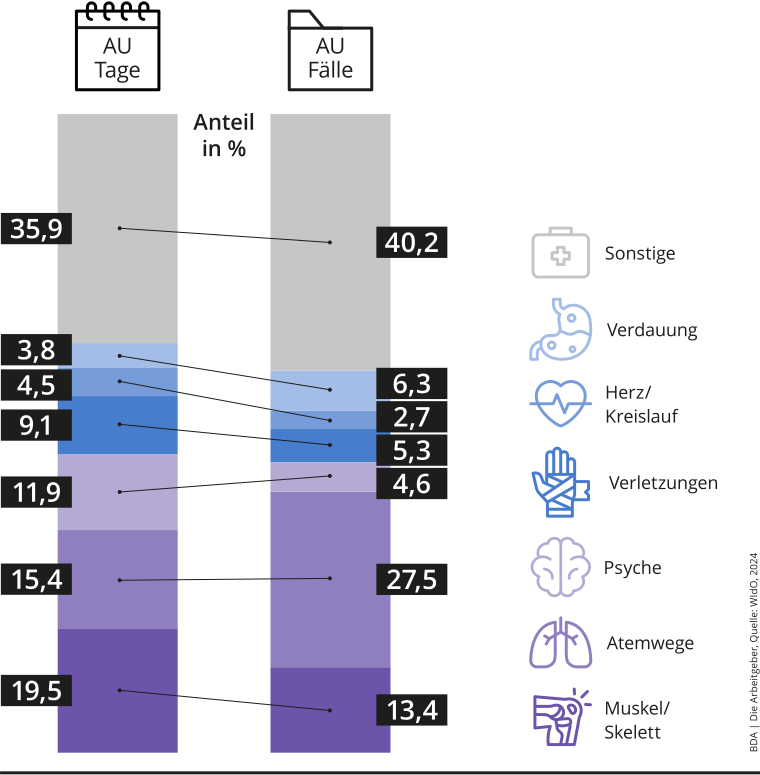
Mental health conditions are becoming increasingly prominent in health insurance statistics – diagnoses of these conditions are now among the most common causes of long-term sick leave. The average duration of a case in 2024 was 33 days of sick leave (DAK Mental Health Report, 2025). Around 20% of all days of absence are attributable to mental health diagnoses (TK Health Report, 2024). Nevertheless, mental illnesses rank only fifth as a reason for sick leave certificates, and in terms of duration they also lag behind musculoskeletal and respiratory conditions.
Nevertheless, mental illnesses appear to be on the rise in the general population as well (including undiagnosed cases), at least in the areas of depression and anxiety disorders. Young women in particular appear to be affected (Walter et al., 2024). One explanation cited is destigmatisation – mental health conditions are now, fortunately, recognised earlier, diagnosed more frequently and discussed more openly (Schomerus et al., 2023) – but also the pandemic period and numerous crises (Walter et al., 2024).
Incapacity for work among AOK members by type of illness in 2024
New challenges in the world of work
Changes in the world of work bring with them new pressures – these can have both positive and challenging effects on mental health. For example, AI can help to organise tasks more quickly and easily, summarise texts, or even reduce emotional stress by, for instance, using AI to draft replies to unfriendly emails from customers. However, new technologies can, for example, lead to employees feeling socially isolated. In fact, AI is already an integral part of the daily work of many employees – yet results from the BIBB/BAuA 2024 Employment Survey show: Since 2006, psychological stressors have been on the decline, such as intense deadline and performance pressure and very fast-paced work (−11 and −14 percentage points respectively), whilst the overall intensity perceived as stressful remains at the 2018 level (Siefer & Hünefeld, 2025).
We demand:
Enabling better support for people with mental health issues
Employees who are already experiencing mental health issues receive support within the company, for example through
- in-house mental health first aiders,
- EAP services
- and effective workplace integration management (BEM)
according to the findings of the Federal Ministry of Labour’s policy workshop on mental health. It is often necessary to find individual solutions and to ensure a sustainable return to work – which is difficult when support is often lacking. At the same time, it is important to note that companies cannot replace medical and therapeutic care.
It is therefore crucial that:
- employees who are unwell receive professional help quickly and easily when needed.
- The expansion of suitable care structures remains a task for society as a whole – successful reintegration can only be achieved through the interplay of workplace support and external treatment.
- Furthermore, it is necessary for social security providers (such as health insurance funds, accident insurance, pension insurance, the Federal Employment Agency and the Integration Service), which are responsible for people with mental health issues and offer corresponding benefits, to engage in increased and more coordinated cooperation.
An overview of the services offered by social insurance providers for mental stress and mental health issues is provided by THE MENTAL HEALTH PREVENTION GUIDE. This guide originated from the “PsyGAP” project run by the Federal Ministry of Labour and is constantly updated.
Further information:
- Information bzw. eine Landkarte zu den Angeboten der Sozialversicherungsträger hinsichtlich psychischer Belastung und Gesundheit: Präventionsguide Psyche
- Berufsgenossenschaft Handel und Warenlogistik: Ausbildung betrieblicher psychologischer Erstbetreuerinnen und Erstbetreuer
- Deutsche Stiftung Depressionshilfe: Welchen Einfluss hat die Arbeit auf die Entstehung einer Depression?
- Quarks: „Darum ist Burnout keine Krankheit“
- Gemeinsame Erklärung „Psychische Gesundheit in der Arbeitswelt“ (von BMAS, BDA und DGB)